
Web Development
EV Charging Management Platform
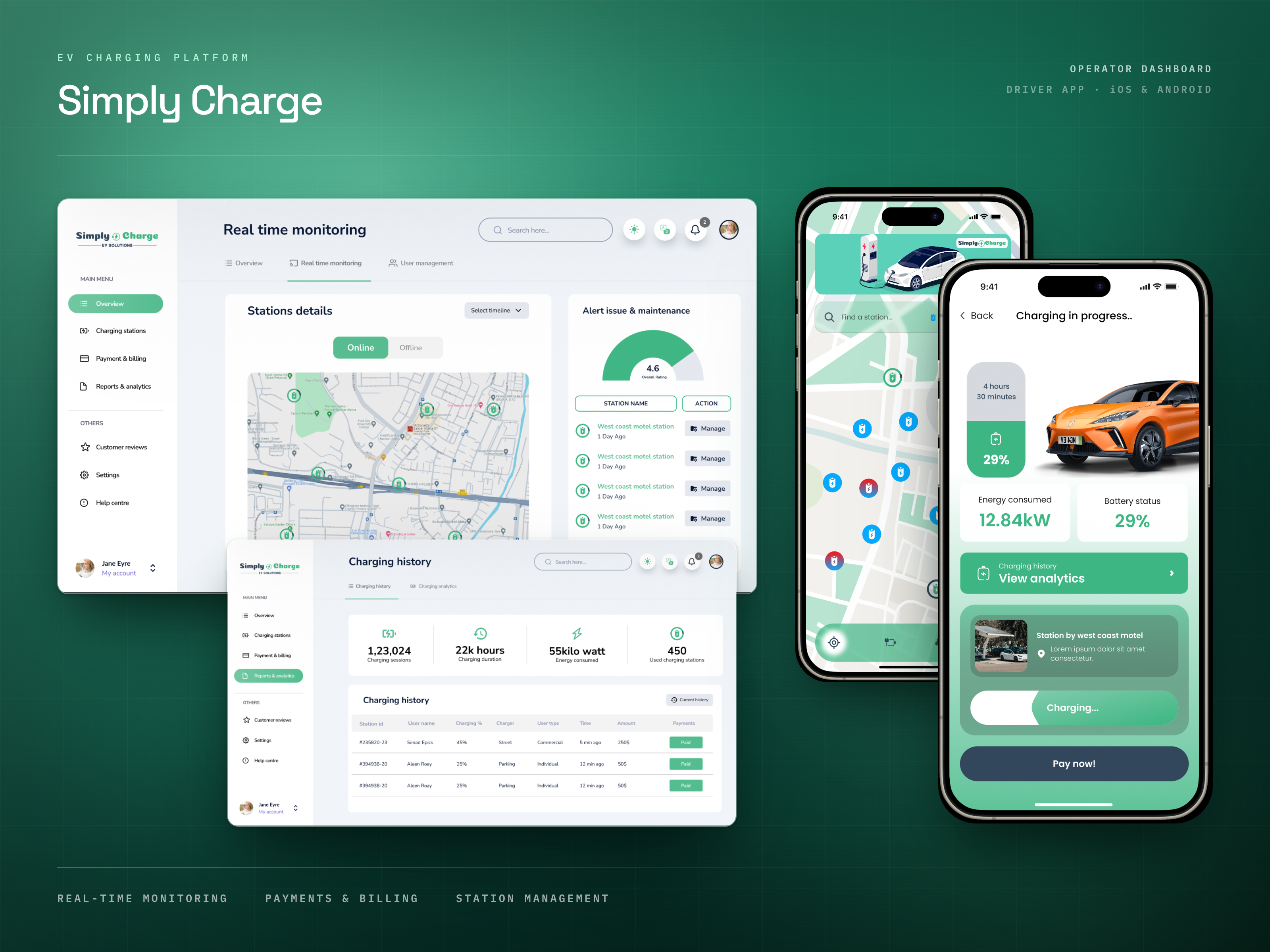
A full charging network platform built on the OCPP protocol — every charger talks to the dashboard in real time: live power, session energy, driver payments, and station health.
The challenge
Drivers in Bosnia and Croatia could find a charger. Almost everything after that was guesswork.
Charging points belonged to different operators, each with its own way in, and no shared payment layer sat across them. There was no way to pay online, no way to see whether a station was free or faulty before driving to it, and no way to watch a session's progress from a phone once it started.
The harder gap was planning a journey. Range anxiety isn't really about range — it's about not knowing whether the next charger will be working, occupied, or reachable on the charge left in the battery. Nothing in the region combined a live view of the network with routing that understood the car's current state of charge, so every longer trip was planned on optimism.
And the chargers themselves were part of the problem. The hardware worked, but the on-unit interfaces were poor enough that starting a charge manually was a small ordeal — a bad first thirty seconds for a driver who had already made a decision to go electric.
What we built
An end-to-end platform on OCPP 1.6, the open protocol charging hardware speaks, with a mobile app as the driver's real interface to the network.
A live link to every charger. Each unit holds a persistent WebSocket connection to the platform rather than being polled on a timer. That distinction is what makes the rest possible: station status, session energy and fault conditions arrive as they happen, so the map a driver is looking at reflects the network as it is, not as it was a minute ago. It also means the platform can start and stop a charge remotely, which is what lets the app replace the hardware's own controls.
The app as the interface, not an accessory. Because the on-unit UI was the weakest part of the experience, we moved the whole interaction into the phone: find a station, check it's free, start the session, watch power and energy climb live, stop it, pay. The driver never has to work out what a particular manufacturer's screen wants from them.
Payment built into the session, not bolted beside it. Online payment was simply absent from the market. Charging and paying became one flow rather than two systems a driver has to reconcile.
Routing that knows the battery. Turn-by-turn navigation and trip planning that take the vehicle's current charge percentage as an input, so the route is built around where the car can actually reach and which stations are live at the time of asking — not a static map of where chargers exist.
Multi-vendor from the start. OCPP is an open standard, but manufacturers implement it with their own quirks. A network that only speaks to one vendor's hardware isn't a network, so the integration layer was built to absorb those differences rather than assume a single supplier.
Delivered by a full team — planning and strategy through engineering to DevOps — and still maintained by us today.
The outcome
Bosnia and Croatia went from having chargers to having a network: one place to see every station's live status, one way to pay, and trip planning that accounts for the charge in the car rather than the map on the wall.
More than 1,200 chargers are connected across the two countries, and the platform held 99.9% uptime through the first half of 2026 — the number that matters most for infrastructure, because a charging platform that is down is indistinguishable from a charger that is broken.
We still run it. The engagement didn't end at launch; the same team that built the platform maintains it in production.
[NEEDS YOU] What did the operator gain commercially — were they able to add sites faster, enter a second country, stop doing something by hand, or bring on other operators' chargers? One concrete sentence here is worth more than any technical paragraph above it, because it's the one a buyer maps onto their own business.
Let's build your next digital product
Tell us what you're building. A senior engineer reads every message and replies within one business day.